From Laboratory Curiosity to Medical Miracle
Picture this: a molecular tool so precise it can locate a single misspelled word in a library containing all the books ever written, then correct that error with surgical accuracy. This isn’t science fiction. It’s CRISPR-Cas9 gene editing, and it’s changing medicine in ways that seemed impossible just two decades ago. Our genome contains roughly 3.2 billion base pairs of DNA, yet researchers can now target and modify individual sequences with remarkable precision. That still blows my mind.
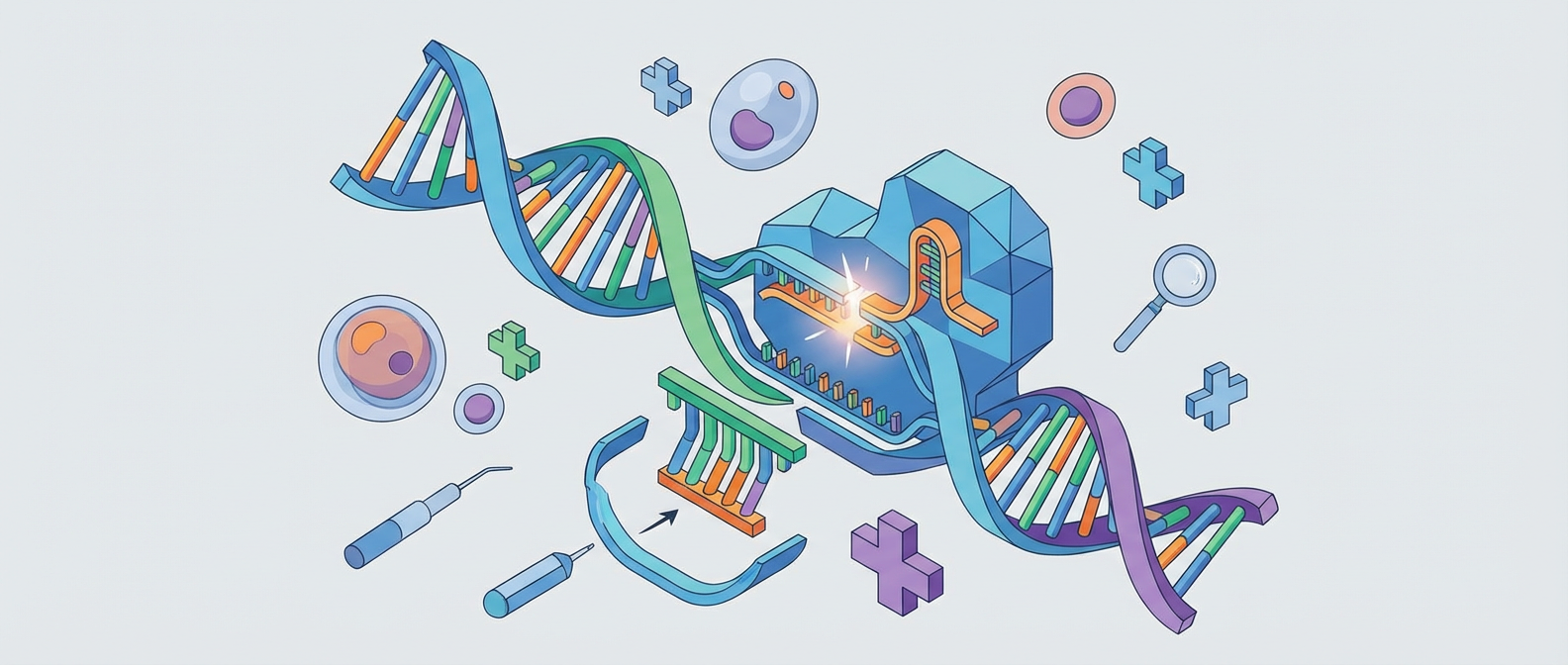
The journey from laboratory bench to patient bedside hit a major milestone in 2023 when the FDA approved the first CRISPR-based therapy for sickle cell disease. This breakthrough is more than just one treatment success. It’s the moment when gene editing moved from experimental promise into clinical reality, opening doors to treating thousands of genetic disorders that have affected humanity for millennia.
The Broad Institute CRISPR research community has been instrumental in advancing these technologies, showing how academic innovation can translate into life-changing medical applications. The true scale of CRISPR’s potential becomes clear when you examine the breadth of conditions now under investigation. We’re talking about everything from rare genetic disorders affecting dozens of patients to common diseases impacting millions worldwide.

Precision at the Cellular Level
Consider the mathematical elegance of modern gene editing. Early CRISPR systems, while revolutionary, carried the risk of off-target modifications that could cause unintended genetic changes. Think of trying to edit a specific paragraph in a massive digital library while occasionally making unwanted changes to completely different books. Scientists have now developed base editing approaches that reduce these off-target effects to below 0.1 percent. That’s like finding and correcting a single typo in the entire contents of the Library of Congress while making fewer than one unintended change per thousand attempts.
This precision improvement has opened new therapeutic pathways previously considered too risky. Clinical trials for transthyretin amyloidosis now use in-vivo gene editing, where the molecular machinery gets delivered directly to patients’ organs to correct disease-causing mutations. Unlike traditional approaches requiring cell extraction, modification, and reimplantation, these techniques work inside the body’s natural environment, editing genes where they actually live.
The implications are huge. Where earlier gene therapies might help hundreds of patients annually, improved precision enables treatment of conditions affecting thousands or tens of thousands of individuals. Each small improvement in accuracy exponentially expands the population that can safely benefit from genetic modification.
The Economics of Molecular Medicine
Here’s where scale reveals both promise and challenge, and honestly, it gets complicated fast. Current gene therapy treatments cost between one and three million dollars per patient. At first glance, these figures seem outrageous. But consider the alternative: these therapies often represent one-time interventions that replace lifelong medical management costing hundreds of thousands annually.
The economics get messier when you examine production scales. Manufacturing personalized genetic medicines requires sophisticated facilities, extensive quality control, and highly trained personnel. Unlike traditional pharmaceuticals produced in massive batches, many gene therapies are essentially bespoke molecular interventions. Each one requires individual preparation and testing. This artisanal approach to medicine, while scientifically remarkable, creates inherent cost pressures that nobody’s quite figured out how to solve.
Industry observers, including analysts at STAT News biotech, regularly examine these cost dynamics. They note that scale efficiencies may eventually drive prices down as techniques mature and production processes become more standardized. The pharmaceutical industry faces a fundamental question: how to balance innovation incentives with accessibility demands. There’s no easy answer.
Global Regulatory Divergence
The international regulatory differences are fascinating and frankly a bit frustrating. Agricultural gene editing provides a perfect example. The United States generally treats gene-edited crops similarly to conventionally bred varieties when the modifications could theoretically occur naturally. The European Union, conversely, subjects most gene-edited agricultural products to the same rigorous oversight required for traditional genetically modified organisms.
These regulatory differences create a patchwork of innovation environments that can be maddening to navigate. A gene-edited crop variety approved in the United States might require years of additional testing before European approval, if it gets approval at all. This divergence affects not just agricultural development but medical research, since many techniques transfer between agricultural and therapeutic applications.
The implications extend beyond individual approvals to entire research ecosystems. Countries with streamlined regulatory pathways attract more investment and talent, potentially creating competitive advantages in biotechnology development. Meanwhile, nations with restrictive approaches may find themselves importing innovations developed elsewhere, raising uncomfortable questions about scientific sovereignty and technological dependence.
Ethical Frontiers and Future Horizons
The specter of germline editing continues to haunt CRISPR discussions, and for good reason. The 2018 case involving researcher He Jiankui, who used gene editing on human embryos, intensified global debates about acceptable boundaries for genetic modification. His actions, widely condemned by the scientific community, highlighted the potential for misuse while simultaneously demonstrating the technology’s power to create heritable genetic changes. It was a wake-up call that still reverberates today.
These ethical considerations operate at multiple levels simultaneously, and they’re genuinely difficult to untangle. Individual patient autonomy, family genetic legacies, and species-wide genetic heritage all intersect when discussing heritable modifications. The scientific community grapples with questions that extend far beyond current capabilities: should we eliminate genetic diseases that also confer certain advantages? How do we ensure equitable access to genetic enhancements? What constitutes acceptable risk when modifying the human germline?
The scale of these ethical challenges matches the scale of the technology’s potential impact. CRISPR could theoretically eliminate entire categories of human genetic disease, but such power demands unprecedented responsibility in its application. Current scientific consensus favors continuing research while maintaining strict barriers against clinical germline editing until safety and ethical frameworks mature. Whether that consensus will hold as the technology advances remains to be seen.
As CRISPR technology continues advancing, the most fascinating questions may not be what we can edit, but what we should edit. The molecular precision now achievable forces us to consider genetic modification not as a distant possibility, but as a present reality requiring careful navigation. The conversations happening today in laboratories, ethics committees, and regulatory agencies will shape not just individual treatments, but the future relationship between humanity and its own genetic code. That’s both exciting and a little terrifying.